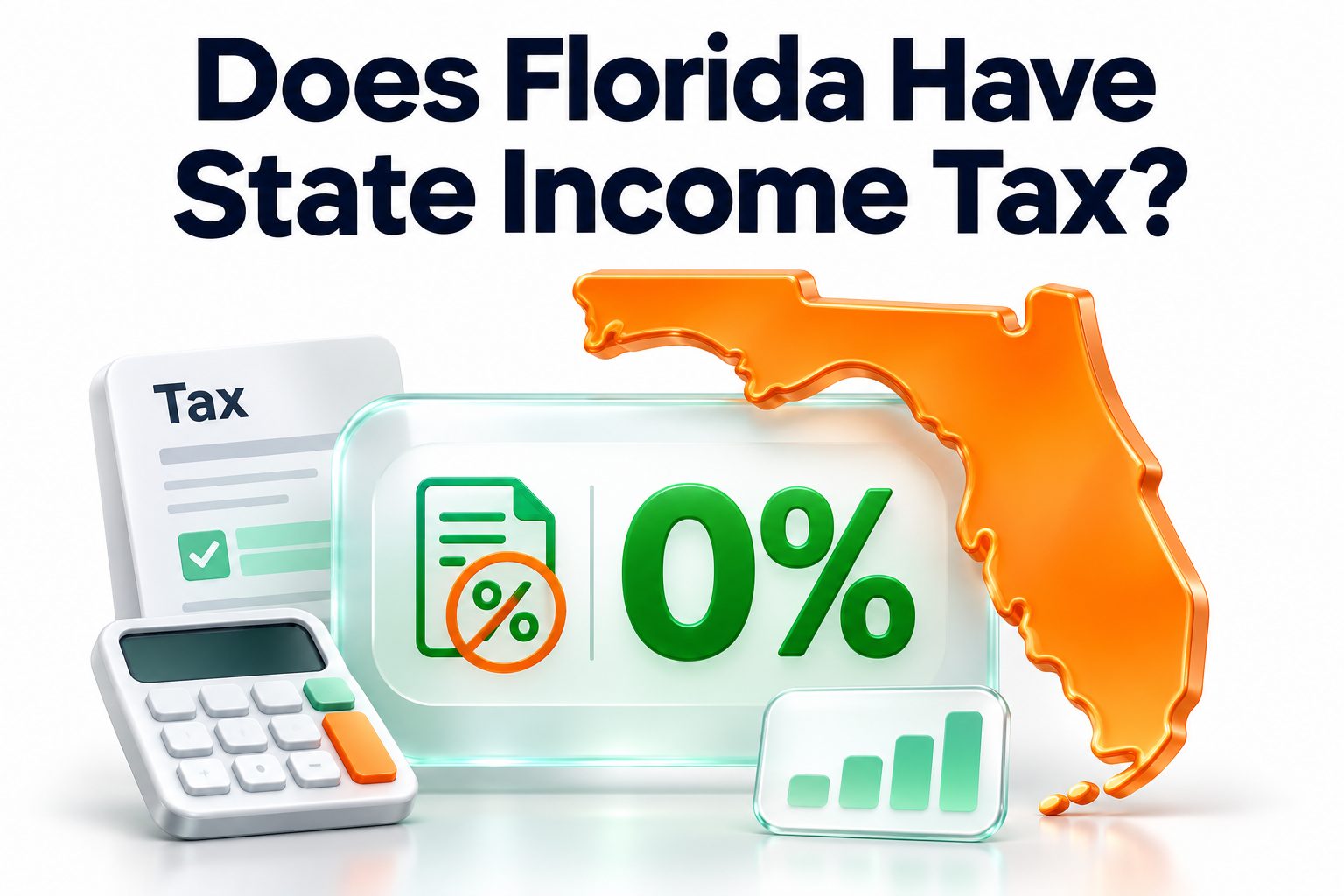
Does Florida have state income tax? For individuals, the answer is no. Florida does not impose a personal state income tax on wages, salaries, self-employment earnings, retirement distributions, investment income, or most other income earned by natural persons. Residents generally do not file an individual income tax return with the Florida Department of Revenue.
That does not mean living in Florida makes all income tax-free. Florida residents may still owe federal income tax, federal self-employment tax, payroll taxes, property tax, sales tax, and other state or local charges. Businesses can also face Florida corporate income tax and industry-specific taxes.
The distinction is especially important for employees, retirees, remote workers, investors, and people moving from another state. Your Florida residence may eliminate personal state income tax going forward, but income connected to another state can remain taxable there. This article explains what Florida’s tax policy covers, which taxes residents still pay, how moving affects state returns, and what business owners and remote workers need to consider.
Florida Does Not Tax Personal Income
Florida is one of the states that does not levy a broad individual income tax. An employee who lives and works entirely in Florida generally has no Florida income tax withheld from a paycheck and does not file a Florida individual income tax return at the end of the year.
The same treatment generally applies to income earned by sole proprietors and independent contractors who are Florida residents. Their profits can still be subject to federal income tax and self-employment tax, but Florida does not impose a separate personal income tax on those earnings.
Income Florida Does Not Tax at the Individual Level
Florida’s lack of personal income tax covers more than ordinary wages. The state generally does not tax an individual’s interest, dividends, capital gains, pension payments, traditional retirement account distributions, or Social Security benefits.
Federal rules remain separate. A stock sale that produces a taxable capital gain, for example, can increase a Florida resident’s federal tax bill even though Florida does not assess an individual capital gains tax. Traditional IRA withdrawals may also be federally taxable despite receiving no Florida income tax treatment.
Federal Income Tax Still Applies in Florida
Moving to Florida does not remove your federal filing obligations. Residents must still determine whether they are required to file Form 1040 based on factors such as gross income, age, filing status, self-employment earnings, and certain special taxes.
Employers in Florida normally withhold federal income tax when required, along with Social Security and Medicare taxes. Because no Florida personal income tax is being withheld, a pay stub may show fewer state deductions than one issued in a state with an individual income tax.
Self-employed residents usually need to make federal estimated tax payments when withholding and refundable credits will not cover their expected liability. The absence of state estimated income tax payments can simplify planning, but it does not reduce federal self-employment tax or federal tax on business profit.
Important facts for Florida residents:
- Florida does not require a personal state income tax return.
- Federal Form 1040 requirements still apply.
- Social Security and Medicare taxes still apply to covered wages.
- Self-employed people may owe federal income and self-employment taxes.
- Federal tax may apply to retirement withdrawals, investment gains, and part of some Social Security benefits.
- Income connected to another state may require a nonresident or part-year return there.
- A Florida mailing address alone does not automatically establish Florida residency.
Taxes Florida Residents Still Pay
Florida funds public services through other revenue sources, so its lack of individual income tax should not be confused with an absence of taxation. Sales and use taxes, property taxes, fuel taxes, corporate taxes, and tourism-related charges all contribute to state and local revenue.
The overall impact depends on how a household earns and spends money. A high-income household may save substantially by avoiding state income tax, while a household that spends a large share of its earnings on taxable goods may feel the effect of sales taxes more directly.
Sales and Use Tax
Florida imposes a statewide sales tax on many retail purchases, commercial rentals, admissions, and certain services. Counties may add a discretionary sales surtax, which means the combined rate varies by location and sometimes by the type or value of the transaction.
Many groceries and prescription medicines are exempt, but prepared food, restaurant meals, household goods, and numerous other purchases may be taxable. Use tax can also apply when taxable property is purchased without Florida sales tax and then brought into or used within the state.
Property Tax
Property taxes in Florida are primarily local rather than state-level charges. Counties, municipalities, school districts, and special districts use assessed property values and local millage rates to calculate the amount due.
Owners who make a Florida home their permanent residence may qualify for the homestead exemption. Eligible homesteaded property can also receive assessment protections under the Save Our Homes rules. These benefits are not automatic in every situation, so a new owner generally must apply through the county property appraiser.
Other Taxes and Charges
Drivers pay taxes included in the price of fuel, and vehicle owners face registration expenses. Florida also imposes documentary stamp taxes on certain real estate documents and financing transactions. Hotels and short-term rentals may be subject to state sales tax and local tourist development taxes.
Homeowners should account for insurance premiums, association fees, and special assessments as well. These are not income taxes, but they can materially affect the cost of living, particularly in coastal communities or condominium developments.
Florida Compared With States That Tax Income
The most visible difference appears on a worker’s paycheck. In a state with a broad personal income tax, the employer may withhold both federal and state income tax. A Florida employer generally withholds only the applicable federal amounts and payroll taxes for an employee working in Florida.
The actual savings depend on the former state’s rate, deductions, credits, and sourcing rules. Comparing only headline tax rates can produce a misleading result because states differ in property taxes, sales taxes, exemptions, and the treatment of retirement or investment income.
| Tax category | Florida individual | Resident of a state with income tax |
|—|—|—|
| Tax on wages | No Florida personal income tax | Often subject to state income tax |
| State individual return | Generally not required | Usually required when filing thresholds are met |
| Capital gains | No Florida individual capital gains tax | Often included in state taxable income |
| Retirement income | No Florida personal income tax | Treatment varies by state and income type |
| Federal income tax | Still applies | Still applies |
| Property tax | Local taxes apply | Local taxes generally apply |
| Sales tax | State and local rates may apply | Depends on the state and locality |
| Out-of-state income | May be taxed by the source state | Residence and source-state rules may apply |
A useful comparison should estimate the full annual cost rather than focusing on one category. Housing, insurance, sales tax, transportation, and local assessments can offset part of the income-tax advantage, depending on a person’s location and spending habits.
Readers comparing several destinations may also find [Internal Link: States With No Individual Income Tax] helpful when evaluating income taxes alongside housing and other recurring costs.
Moving to Florida During the Tax Year
A midyear move often creates filing obligations in the state you left. Suppose someone moves from New York to Florida on July 1. Florida generally will not require an individual income tax return, but New York may require a part-year resident return covering the period before the move.
The former state may also tax income sourced there after the move. Examples can include rent from property located in that state, compensation for services performed there, or profit from a business operating there. The exact sourcing rules differ, so the result depends on the state and income involved.
Establishing Florida Domicile
Domicile is your permanent legal home—the place you intend to return to and remain in. You can have several residences, but generally only one domicile at a time. Buying or renting a Florida property does not necessarily end your domicile in another state.
States examine conduct as well as stated intent. They may review where you spend time, maintain your primary home, register vehicles, vote, receive important mail, work, claim property exemptions, and keep valuable personal belongings. No single step necessarily decides every residency dispute.
Residency Checklist for New Florida Residents
1. Record the date you permanently moved and keep travel records.
2. Establish a genuine primary home in Florida.
3. Obtain a Florida driver license when required.
4. Register vehicles in Florida within the applicable deadline.
5. Register to vote in Florida and update voter registration elsewhere.
6. Update tax records, financial accounts, insurance policies, and legal documents.
7. File a declaration of domicile when appropriate.
8. Apply for the homestead exemption if eligible.
9. Avoid claiming resident-only benefits in your former state.
10. Keep documents showing that Florida is your permanent home.
These actions should reflect reality rather than serve as paperwork alone. Someone who claims Florida residency but continues living, working, and maintaining their strongest connections in another state may face questions from that state’s tax authority.
Remote Work and Multistate Income
A Florida resident who performs all employment services from a Florida home typically owes no Florida personal income tax. Whether another state can tax those wages depends on where the work is performed, where the employer is located, and the other state’s sourcing laws.
Some states apply special rules to remote employees working outside the employer’s state. A state may treat certain remote workdays as employer-state workdays unless the remote arrangement meets a qualifying business need. These rules can create nonresident filing obligations even when the employee lives in Florida.
Employer Withholding Problems
Payroll records do not always update correctly after a move. An employer might continue withholding tax for the former state or begin withholding for the employer’s state even though the employee works in Florida. Employees should check their first pay statements after changing their work location.
Incorrect withholding does not necessarily prove that the tax is owed. It may be necessary to file a nonresident or part-year return to calculate the actual liability and request a refund. Employees should also submit updated withholding and address forms to payroll promptly.
Business Travel Outside Florida
Work performed temporarily in another state can create taxable income there. A Florida-based consultant who spends several weeks serving clients on-site in another state, for example, may cross that state’s filing threshold.
Thresholds vary widely. Some states use income amounts, some count workdays, and others apply tax from the first day of in-state services. Remote employees and traveling professionals should maintain a calendar showing where each workday occurred.
Quick tips for remote and traveling workers:
- Confirm that payroll lists Florida as both your residence and regular work location.
- Review every state abbreviation shown on Form W-2.
- Track days worked in each state rather than relying on memory.
- Ask whether the employer’s state uses a special remote-work sourcing rule.
- Keep written approval for a permanent remote-work arrangement.
- Do not assume that Florida residency prevents every other state from taxing wages.
- Seek professional advice when working regularly across state lines.
Retirement Income in Florida
Florida is popular with retirees partly because it does not impose personal income tax on pensions, IRA distributions, 401(k) withdrawals, annuity income, or Social Security benefits. This can produce meaningful state tax savings for someone moving from a jurisdiction that taxes some or all retirement income.
Federal tax treatment does not change merely because a retiree lives in Florida. Traditional retirement account distributions are generally included in federal taxable income, while qualified Roth withdrawals are generally tax-free. Depending on total income and filing status, part of Social Security benefits may also be federally taxable.
Timing a Move and Retirement Distribution
People planning a large retirement withdrawal sometimes consider establishing Florida residency before taking the distribution. That timing may matter if the former state taxes retirement income based on residency when it is received.
A rushed or poorly documented move can invite a residency challenge. The taxpayer should have genuinely changed domicile before relying on Florida’s tax treatment. Deferred compensation, stock options, and certain pension payments may also be governed by special federal or state sourcing rules.
Estate and Inheritance Tax Considerations
Florida does not impose a separate state estate tax or inheritance tax under its current system. A beneficiary therefore does not pay Florida inheritance tax simply because inherited property or money is received while living in the state.
Federal estate tax can still apply to sufficiently large estates. Property located in another state may also be affected by that state’s estate, inheritance, probate, or property-tax rules. Estate planning should consider asset location, ownership structure, beneficiary designations, and federal requirements.
Investment and Rental Income
Florida does not impose individual income tax on dividends, taxable interest, or capital gains. An individual who sells stocks at a profit can still owe federal capital gains tax, including the net investment income tax when the federal requirements are met, but no Florida personal capital gains return is required.
The location of an asset can matter when another state is involved. Gains from intangible investments such as publicly traded stock are commonly associated with the owner’s domicile, but real estate and business interests can follow different sourcing rules.
Rental Property Outside Florida
A Florida resident who owns rental property in another state will often need to file a nonresident return in that state. Rental income is generally sourced to the location of the real estate, not merely to the owner’s home.
The same principle can apply when the property is sold. The state where the real estate is located may tax the gain even though the seller is a Florida resident. Federal reporting and depreciation recapture rules may also affect the transaction.
Florida Rental Activity
An individual earning long-term rental income from Florida property generally does not pay Florida personal income tax on the profit. Federal income tax still applies, and the owner must follow applicable local licensing, property-tax, and landlord requirements.
Short-term rentals can trigger additional obligations, including sales tax and local tourist development tax. Owners should determine who collects and remits those taxes because a booking platform may handle some charges but not every state or local obligation.
Practical examples:
- A Florida resident sells shares at a $20,000 gain. The gain may be federally taxable, but Florida does not levy individual capital gains tax.
- A Florida resident receives a traditional IRA distribution. Federal income tax may apply, but Florida personal income tax does not.
- A Florida resident owns a Georgia rental property. Georgia may require a nonresident return for the rental income.
- A new Florida resident sells a former home in another state. That state may tax the gain under its real-property sourcing rules.
- A host rents a Florida condo for one-week stays. Sales tax, tourist tax, registration, and local rules may apply even though Florida has no personal income tax.
For more detail on investment sales and federal obligations, see [Internal Link: Capital Gains Tax for Individuals].
Business Taxes in Florida
The absence of personal income tax does not mean every Florida business operates income-tax-free. Florida imposes a corporate income and franchise tax on corporations and entities treated as corporations for federal tax purposes. The general rate is 5.5 percent for taxable years beginning on or after January 1, 2022, subject to exemptions, adjustments, and legislative changes.
Corporations generally calculate Florida tax using federal taxable income as a starting point, followed by Florida-specific additions, subtractions, allocation, and apportionment rules. Filing can be required even when little or no tax is ultimately due.
Sole Proprietorships and Pass-Through Entities
A sole proprietorship is not separately taxed by Florida as an individual corporation. Its profit passes to the owner, who may owe federal income and self-employment taxes but generally does not owe Florida personal income tax on that profit.
Partnerships, limited liability companies, and S corporations require closer attention. Their tax treatment depends on federal elections, activities, ownership, and whether the entity itself owes federal corporate income tax. An LLC is a legal form, not a single tax classification.
Other Business Obligations
A business may need to register for sales and use tax, reemployment tax, communications services tax, fuel tax, or other industry-specific programs. Employers also have federal payroll tax responsibilities and Florida reemployment tax obligations.
Businesses operating in more than one state may owe tax outside Florida. Selling to customers, employing remote workers, storing inventory, owning property, or performing services in another jurisdiction can create tax nexus or filing duties there.
Common business mistakes include:
- Assuming an LLC never has to file a Florida tax return.
- Confusing Florida’s lack of personal income tax with an exemption from federal tax.
- Failing to register for sales tax before making taxable sales.
- Overlooking local business tax receipts and licensing requirements.
- Treating short-term rental receipts like ordinary long-term rent.
- Ignoring another state’s filing rules when employees or customers are located there.
- Using personal and business accounts interchangeably.
- Missing corporate estimated payment or return deadlines.
Calculating the Financial Benefit of Florida Residency
A simple estimate starts with the state income tax you would otherwise pay, not merely the former state’s top rate. Review the actual state tax from a recent return, then adjust for expected changes in income, deductions, credits, and residency.
Next, account for differences in housing, property tax, homeowners insurance, sales tax, transportation, association fees, and local assessments. Florida may still provide a strong financial advantage, but the net benefit is personal rather than automatic.
Example Household Comparison
Consider a married couple expecting $160,000 of taxable wages and investment income. If their former state would impose $8,000 of net individual income tax, living and working entirely in Florida could eliminate that state-level charge.
Suppose their annual homeowners insurance and property-related costs rise by $4,500 after the move. Their rough net advantage would be closer to $3,500 before accounting for sales taxes, housing prices, moving costs, and other lifestyle differences.
A Practical Review Process
1. Use the state income tax shown on your latest return as a starting point.
2. Adjust for your expected wages, retirement income, business profit, and investments.
3. Identify income another state can continue taxing after the move.
4. Estimate Florida property tax using the specific property and local millage rates.
5. Obtain realistic insurance quotes before buying a home.
6. Compare taxable spending, vehicle costs, and association fees.
7. Include one-time moving and property transaction costs.
8. Review the estimate with a qualified tax professional when multiple states or businesses are involved.
This approach produces a more useful result than multiplying total income by another state’s highest marginal rate. Tax brackets are progressive in many jurisdictions, while deductions and credits can significantly change the effective rate.
Conclusion
Florida does not impose a personal income tax on individuals, so residents generally do not file a Florida individual return or pay state tax on wages, investment earnings, capital gains, pensions, or retirement account distributions. Federal income tax, payroll tax, and self-employment tax remain in place, and other states may tax income connected to them.
That distinction matters when moving, working remotely, owning out-of-state property, or traveling for business. Establishing genuine Florida domicile requires more than changing an address, and a former state may request evidence showing when residency ended. Businesses must also separate personal tax rules from Florida corporate, sales, payroll, and industry-specific obligations.
The practical answer to does Florida have state income tax is therefore simple for individuals, but the full tax picture requires more context. Compare total living costs, review the sourcing of every major income stream, and keep clear residency and work-location records. For a straightforward Florida-only household, filing is usually simpler. Multistate workers, investors, landlords, and business owners may benefit from professional advice tailored to their circumstances.
Frequently Asked Questions
Do Florida residents file a state income tax return?
No. Florida does not impose a personal income tax, so individuals generally do not file a Florida income tax return. They may still need a federal return and returns in other states where income was earned.
Does Florida tax Social Security benefits?
No. Florida does not tax Social Security benefits at the state level. Depending on filing status and other income, up to part of those benefits may still be included in federal taxable income.
Does Florida tax pensions and 401(k) withdrawals?
No. Florida does not impose individual income tax on pensions, 401(k) distributions, or IRA withdrawals. Traditional retirement distributions may remain federally taxable, while qualified Roth distributions are generally tax-free under federal rules.
Does Florida tax capital gains?
Florida does not tax an individual’s capital gains. Federal capital gains tax may still apply, and another state may tax a gain from real estate or business property located within that state.
Can another state tax a Florida resident?
Yes. Another state may tax a Florida resident on income sourced there, including wages for work performed there, rental income from local property, or business earnings connected to that jurisdiction.
Leave a Comment