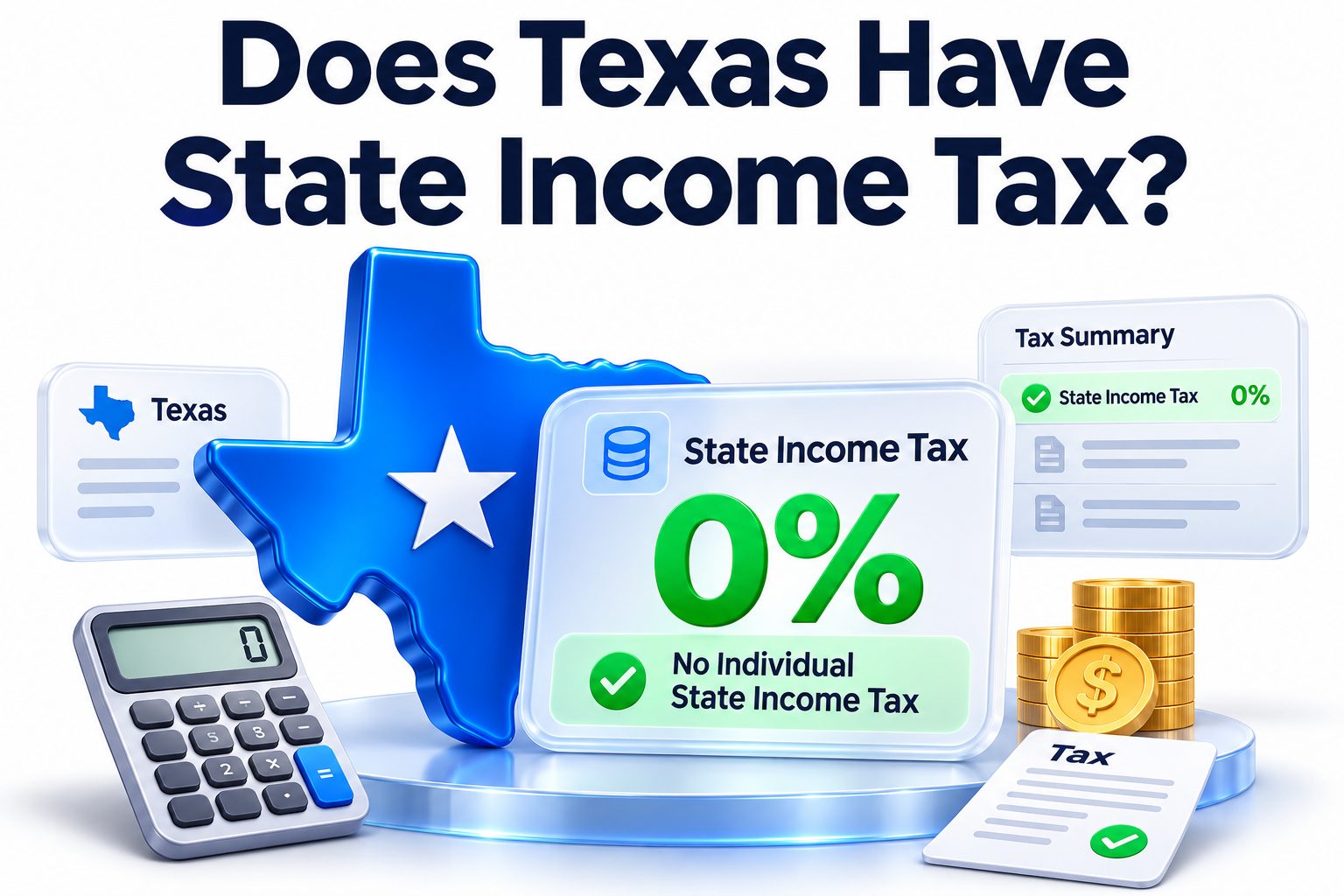
Texas does not impose a personal state income tax. If you earn wages, receive retirement income, operate as a sole proprietor, or collect investment income while living in Texas, you generally will not file an individual income tax return with the state. That is the direct answer to “does Texas have state income tax,” but it does not mean Texans pay no taxes or that every dollar earned is tax-free.
Most residents still owe federal income tax. They may also pay state and local sales taxes, locally administered property taxes, and various taxes or fees tied to specific purchases. Business owners face separate rules, including the Texas franchise tax for many entities. People who work across state lines can also owe income tax to another state even while residing in Texas.
This article explains what Texas’s no-income-tax policy covers, which taxes residents still pay, how moving or working across state lines affects filing, and what employees, retirees, investors, and business owners should check before tax season.
Texas Has No Personal State Income Tax
Texas does not tax the personal income of individuals. The state does not take a percentage of residents’ wages, salaries, tips, self-employment earnings, pensions, Social Security benefits, interest, dividends, or capital gains through a conventional individual income tax.
As a result, most people whose income is connected only to Texas do not need to prepare a Texas individual income tax return. There is no Texas equivalent of the federal Form 1040 for residents, and employers generally do not withhold Texas income tax from employee paychecks.
What the No-Income-Tax Rule Covers
The rule applies broadly to individual income, including compensation from a Texas employer and profits reported by a sole proprietor on a federal return. Texas also does not create a separate personal income tax bill for investment earnings or distributions from a retirement account.
This can simplify annual filing for households whose financial lives remain entirely within the state. It does not remove federal reporting requirements, nor does it override another state’s authority to tax income earned within that state.
Texas Taxes Residents Still Pay
Texas funds public services through revenue sources other than a personal income tax. Two of the most visible are sales tax and local property tax, although residents may encounter motor vehicle taxes, fuel taxes, hotel occupancy taxes, and other targeted charges.
The practical cost of living in Texas therefore depends on more than take-home pay. Home value, shopping habits, location, insurance expenses, and local tax rates can all affect whether a household’s overall costs are lower than they would be elsewhere.
Important facts about taxes in Texas include:
- The state sales and use tax rate is 6.25 percent.
- Cities, counties, transit authorities, and special-purpose districts may add local sales tax.
- The maximum combined sales and local rate is generally 8.25 percent.
- Texas does not levy a state property tax, but local governments and school districts impose property taxes.
- Many groceries, prescription drugs, and certain medical items receive favorable sales-tax treatment or exemptions.
- A purchase made online is not automatically tax-free. Texas sales or use tax may still apply.
Sales Tax and Use Tax
Texas imposes sales tax on many physical goods and selected taxable services. With local additions, a taxable purchase may carry a combined rate as high as 8.25 percent. The exact rate depends on the applicable local jurisdictions and sourcing rules.
Use tax complements sales tax. It may apply when a buyer obtains a taxable product from an out-of-state seller without paying the proper Texas tax and then stores, uses, or consumes that product in Texas. Consumers and businesses should not assume an untaxed online invoice eliminates the obligation.
Property Taxes
Texas has no state property tax. Instead, local taxing units such as counties, cities, school districts, and special districts set rates and collect property tax. A homeowner’s bill is based on the property’s taxable appraised value and the combined rates of the applicable jurisdictions.
Eligible homeowners may reduce taxable value through residence homestead and other exemptions. Older adults, disabled individuals, veterans, surviving spouses, and certain other owners may qualify for additional relief. Applications generally go through the appraisal district serving the county where the property is located.
Federal Income Tax Still Applies
Living in a state without personal income tax does not remove federal obligations. Texas residents must generally report taxable income to the Internal Revenue Service under the same federal rules that apply in other states. Depending on income and filing status, that can include wages, business profits, interest, dividends, and gains.
Employees commonly see federal income tax, Social Security tax, and Medicare tax withheld from their pay. Self-employed workers may need to make quarterly estimated payments because no employer is withholding these amounts on their behalf. [Internal Link: Federal Income Tax Filing Basics] can help readers distinguish state and federal responsibilities.
A basic filing process looks like this:
1. Gather Forms W-2, 1099, and other income records.
2. Review federal filing requirements based on income, age, and filing status.
3. Calculate federal deductions, credits, and taxable income.
4. Report business or investment activity on the appropriate federal schedules.
5. Check whether income from another state creates a separate state filing duty.
6. File the federal return and any required nonresident or part-year state returns.
Why Texas Can Operate Without Personal Income Tax
Texas relies heavily on sales taxes, business-related revenue, federal funds, fees, and other sources. Local governments and school districts also receive substantial funding from property taxes. This structure shifts the timing and visibility of taxation rather than eliminating the cost of government.
A household may benefit from not losing part of each paycheck to state income tax while paying more through housing or consumption. The result varies by household. A renter who spends little on taxable goods will experience the system differently from a homeowner with a high-value property.
A Constitutional Barrier to a Personal Income Tax
Texas voters approved a constitutional amendment in 2019 that strengthened the restriction on imposing an individual income tax. Creating such a tax would require another constitutional amendment, which involves legislative approval and a statewide vote.
That makes the introduction of a personal income tax more difficult than passing an ordinary bill. Tax laws can still change, so residents making long-term financial plans should verify current rules instead of assuming the system can never be altered.
Employee Paychecks in Texas
A Texas employee’s pay stub ordinarily has no line for Texas personal income tax withholding. Federal income tax, Social Security, Medicare, benefits, retirement contributions, garnishments, and other authorized deductions may still reduce gross pay.
Employees should review their first pay statement after beginning a job. A state withholding line could reflect work performed in another state, an employer setup issue, or a label unrelated to Texas individual income tax. Payroll staff can explain the deduction and correct genuine mistakes.
Employee paycheck checklist:
- Confirm that your name, address, and Social Security number are correct.
- Review federal withholding after a marriage, divorce, new child, or major income change.
- Look for Social Security and Medicare deductions.
- Check health insurance and retirement contributions against your elections.
- Ask payroll about any unfamiliar state or local tax code.
- Keep year-end Forms W-2 with your tax records.
Remote Work and Multistate Employment
A Texas resident working remotely for a company located elsewhere does not automatically owe that company’s home-state income tax. The key issue is often where the employee physically performs the work, although each state has its own residency, sourcing, and remote-work rules.
If the employee travels and performs services in another state, that state may treat some wages as locally sourced. Certain states also apply special rules to remote employees. Workers should track work locations and days rather than relying solely on the employer’s office address.
Working in Another State While Living in Texas
A Texas resident who physically works in a state with an income tax may need to file a nonresident return there. The other state can often tax compensation earned for services performed within its borders, even though Texas itself does not tax the income.
Because Texas has no individual income tax, the resident generally cannot claim a Texas credit for tax paid to the other state. People who cross state lines regularly should review withholding early in the year to avoid a large balance due.
Consider these practical examples:
- A Texas resident commuting to an office in another state may owe that state’s income tax on workday wages.
- A consultant who completes a temporary assignment outside Texas may create a nonresident filing requirement.
- A remote employee performing all services from a Texas home may receive different treatment from an employee who travels monthly.
- A spouse who remains employed in another state after a family move may have part-year or nonresident filing obligations.
- An athlete, entertainer, or traveling professional may owe tax in several jurisdictions based on where work occurs.
Moving to or From Texas During the Year
Moving to Texas does not erase income tax owed to a former state for the part of the year you lived or worked there. Most states with an income tax require a part-year resident return that allocates income between the resident and nonresident periods.
Keep records showing the date your residency changed. A lease, closing statement, driver’s license record, voter registration, utility bill, employment documents, and moving receipts may help demonstrate when Texas became your permanent home. No single action necessarily settles residency if your broader facts point elsewhere.
Maintaining Ties to a Former State
A former state may continue treating someone as a resident when the person keeps a home there, spends substantial time there, or fails to establish a genuine Texas domicile. Residency rules differ, and some states apply statutory day-count tests in addition to domicile standards.
Changing a mailing address alone may not be enough. Tax authorities can consider where a person lives, works, votes, holds licenses, registers vehicles, owns property, maintains professional relationships, and keeps close personal connections.
When relocating, consider these steps:
1. Document the date you leave the former residence and enter the Texas residence.
2. Update your driver’s license and vehicle registration when required.
3. Change voter registration and primary mailing addresses.
4. Notify employers, banks, insurers, and financial institutions.
5. Track days spent in both Texas and the former state.
6. File accurate part-year or nonresident returns where necessary.
7. Retain supporting records in case a state questions the move.
Retirement Income in Texas
Texas does not impose an individual income tax on pensions, withdrawals from traditional retirement accounts, Roth distributions, annuity income, or Social Security benefits. That makes state-level tax filing relatively straightforward for many retirees.
Federal treatment is separate. Traditional IRA and 401(k) withdrawals are often federally taxable, while qualified Roth distributions may be tax-free. Part of a Social Security benefit can also become federally taxable depending on combined income and filing status.
Other Costs Retirees Should Consider
A no-income-tax state is not automatically the lowest-cost retirement destination. Property taxes can be significant, especially for retirees who own valuable homes. Sales taxes, insurance costs, medical access, transportation, and housing expenses also matter.
Texas offers property-tax provisions that may help qualifying older or disabled homeowners, including exemptions and certain tax-ceiling or deferral rules. These benefits have eligibility and application requirements, so owners should contact their local appraisal district rather than assume enrollment is automatic.
Retirement planning tips:
- Compare total annual taxes instead of looking only at income tax.
- Estimate property taxes using the home’s likely taxable value.
- Apply for every exemption for which you qualify.
- Include homeowners, flood, windstorm, and health insurance in the budget.
- Plan for federal tax on retirement-account withdrawals.
- Review the tax impact before selling appreciated investments.
Investment and Rental Income
Texas does not levy personal income tax on an individual’s interest, dividends, or capital gains. An investor who sells stock at a profit may owe federal capital gains tax but generally will not owe Texas individual income tax on the transaction.
Rental income receives similar state treatment when earned by an individual, but federal reporting still applies. Property owners may also face local property taxes and business, sales-tax, hotel-tax, or registration obligations depending on the property’s use and ownership structure.
Short-Term Rentals
Operating a short-term rental can create obligations beyond income tax. Texas state hotel occupancy tax may apply to stays that meet the statutory definition, and cities or counties may impose local hotel taxes, permits, registration rules, or operating restrictions.
A booking platform may collect some taxes, but owners should verify precisely what it handles. Platform collection does not necessarily cover every local filing, permit, or recordkeeping requirement. [Internal Link: Short-Term Rental Tax Requirements] can provide more detail for hosts.
Income type comparison:
Income type | Texas personal income tax | Possible other obligations
Wages | None | Federal income and payroll taxes
Self-employment profit | None | Federal income and self-employment taxes
Pension or IRA withdrawal | None | Possible federal income tax
Interest and dividends | None | Possible federal income tax
Capital gains | None | Possible federal capital gains tax
Long-term rental income | None | Federal tax and local property tax
Short-term rental receipts | None | Federal tax and possible hotel occupancy taxes
Business entity revenue | Not a personal income tax | Possible Texas franchise and sales taxes
Taxes for Freelancers and Sole Proprietors
A freelancer or sole proprietor does not pay Texas personal income tax on net business earnings. The owner generally reports income and deductible expenses on the federal return and may owe federal income tax and self-employment tax.
Estimated federal payments are often necessary when withholding will not cover the expected bill. A common mistake is treating the absence of Texas income tax as permission to spend all incoming cash. Setting aside funds for federal obligations helps prevent a shortfall.
Sales-Tax Responsibilities
Some independent businesses must obtain a Texas sales tax permit and collect tax on taxable products or services. The rules depend on what is sold, how it is delivered, and where the sale is sourced. Not every service is taxable, but selected services are.
Freelancers should classify their offerings carefully rather than relying on an informal description such as “consulting.” Bundled transactions can be especially complicated when one invoice includes taxable and nontaxable items.
Common mistakes made by independent workers include:
- Failing to make federal estimated tax payments.
- Assuming every service is exempt from Texas sales tax.
- Mixing personal and business transactions in one account.
- Ignoring use tax on untaxed business purchases.
- Forgetting local permits or industry-specific fees.
- Treating a limited liability company as automatically exempt from franchise reporting.
- Keeping inadequate mileage, receipt, and expense records.
Texas Business Taxes and the Franchise Tax
Texas does not have a conventional corporate income tax based directly on net profit. It does impose a franchise tax, sometimes called the margin tax, on many taxable entities formed in Texas or doing business in the state.
Corporations, limited liability companies, banks, partnerships, and other entities may fall within the franchise tax system. Sole proprietorships owned directly by individuals are generally treated differently, but entity classification and exemptions should be checked carefully.
Rates, Thresholds, and Reports
For 2026 and 2027 reports, the no-tax-due threshold is $2.65 million in annualized total revenue. The standard rate is 0.375 percent for qualifying retail or wholesale businesses and 0.75 percent for other taxable entities. Eligible entities with revenue of $20 million or less may use the EZ computation rate of 0.331 percent.
An entity at or below the threshold generally owes no franchise tax and is not required to submit a No Tax Due Report for current report years. It may still need to file a Public Information Report or Ownership Information Report. The annual due date is normally May 15.
Business compliance checklist:
- Identify whether the business structure is a taxable entity.
- Confirm the correct report year and annualized revenue.
- Use the threshold and rate assigned to that report year.
- Determine whether an information report remains due even when no tax is owed.
- Review sales-tax permit and filing requirements separately.
- Keep the entity’s mailing address and responsible-party information current.
- File on time to avoid penalties and possible loss of good standing.
- Seek professional help for combined groups, multistate revenue, or complex deductions.
Comparing Texas With States That Tax Income
The absence of personal income tax can increase take-home pay compared with a state that applies tax to the same wages. For example, a worker earning $80,000 does not owe Texas individual income tax merely because of that salary.
That comparison is incomplete without housing and consumption costs. A household moving from a lower-property-tax state could save on income tax while paying more for a home’s annual tax bill. Renters may also bear part of local property taxes indirectly through rent.
A Better Way to Compare Tax Burdens
Start with actual household numbers rather than statewide averages. Estimate the income tax that would apply in the other state, then compare property tax, sales tax, housing, insurance, commuting, and relevant local charges.
The result may differ even between two Texas cities because property values, local sales-tax additions, and housing costs vary. Career opportunities and wages can outweigh tax differences, so tax should be one part of a broader relocation calculation.
A practical comparison might include:
- State income tax on wages and investments
- Local income or payroll taxes
- Property tax or the property-tax portion built into rent
- General and special sales-tax rates
- Vehicle taxes, registration, tolls, and commuting expenses
- Homeowners, renters, flood, and windstorm insurance
- Childcare, healthcare, and utility costs
- Available homestead, senior, veteran, or disability exemptions
Common Misconceptions About Texas Taxes
“No state income tax” is sometimes interpreted as “no state taxes.” Texas still collects substantial revenue from sales taxes, business taxes, fees, and taxes on selected activities. Local property taxes are also a major expense for many households.
Another misconception is that Texas residency protects all income from other states. It does not. A state can often tax income connected to work, property, or business activity within its borders, regardless of where the taxpayer’s permanent home is located.
Do:
- File a federal return when federal rules require one.
- Check other-state filing rules after travel, remote work, or relocation.
- Review local property-tax exemptions.
- Verify sales-tax obligations before selling products or taxable services.
- Keep residency and work-location records.
Don’t:
- File a Texas personal income tax return that does not exist.
- Assume an out-of-state employer’s withholding is automatically correct.
- Ignore a tax notice from another state.
- Confuse the franchise tax with personal income tax.
- Base a relocation decision on income tax alone.
When Professional Tax Help Is Worthwhile
Many Texas residents with only Texas wages can prepare their federal returns without state complications. Professional guidance becomes more valuable when income crosses state lines, residency is disputed, a business operates through an entity, or a household owns property in multiple states.
Help may also be worthwhile after a large business sale, equity compensation event, retirement-account conversion, or significant investment gain. Texas may not tax the income personally, but federal rules and other states’ sourcing rules can still produce a substantial liability.
Before meeting an adviser, gather:
- Federal and other-state tax returns from recent years
- Forms W-2, 1099, K-1, and brokerage statements
- Work calendars showing where services were performed
- Moving and residency records
- Property purchase, sale, and rental documents
- Business formation and franchise tax records
- Sales-tax permits and filed returns
- Notices received from tax agencies
Conclusion
So, does Texas have state income tax? No. Texas does not impose a personal income tax on wages, self-employment earnings, retirement distributions, investment income, or other income received by individuals. Most residents therefore file a federal return but no Texas individual income tax return.
The absence of personal income tax should not be mistaken for an absence of taxes. Texans may pay state and local sales tax, local property tax, use tax, and taxes or fees attached to vehicles, lodging, fuel, and other activities. Business entities may also have franchise tax and information-reporting responsibilities.
Your work location matters as much as your home address. Income earned in another state can create nonresident filing and payment obligations, while moving during the year may require a part-year return in the former state. The clearest approach is to separate federal, Texas, local, and other-state responsibilities, keep reliable records, and review the rules whenever your residence, employment, or business activity changes.
Frequently Asked Questions
Does Texas tax employee wages?
No. Texas does not impose a personal income tax on employee wages. Workers may still have federal income tax, Social Security, Medicare, benefits, and other deductions withheld from their paychecks.
Do Texas residents file a state tax return?
Most residents do not file a Texas individual income tax return because the state has no personal income tax. A separate filing may still be required for franchise, sales, hotel, or other business-related taxes.
Does Texas tax retirement income?
No. Texas does not tax pensions, Social Security benefits, or retirement-account withdrawals through a personal income tax. Federal income tax may still apply depending on the income type, amount, and taxpayer’s circumstances.
Can another state tax a Texas resident?
Yes. Another state may tax income a Texas resident earns from work, property, or business activity within that state. The resident may need to submit a nonresident return and pay the applicable tax.
Does Texas have a corporate income tax?
Texas has no conventional corporate income tax based directly on net profit. Many businesses are instead subject to the franchise tax, which uses taxable margin and includes revenue thresholds, varying rates, and annual reporting requirements.


Leave a Comment