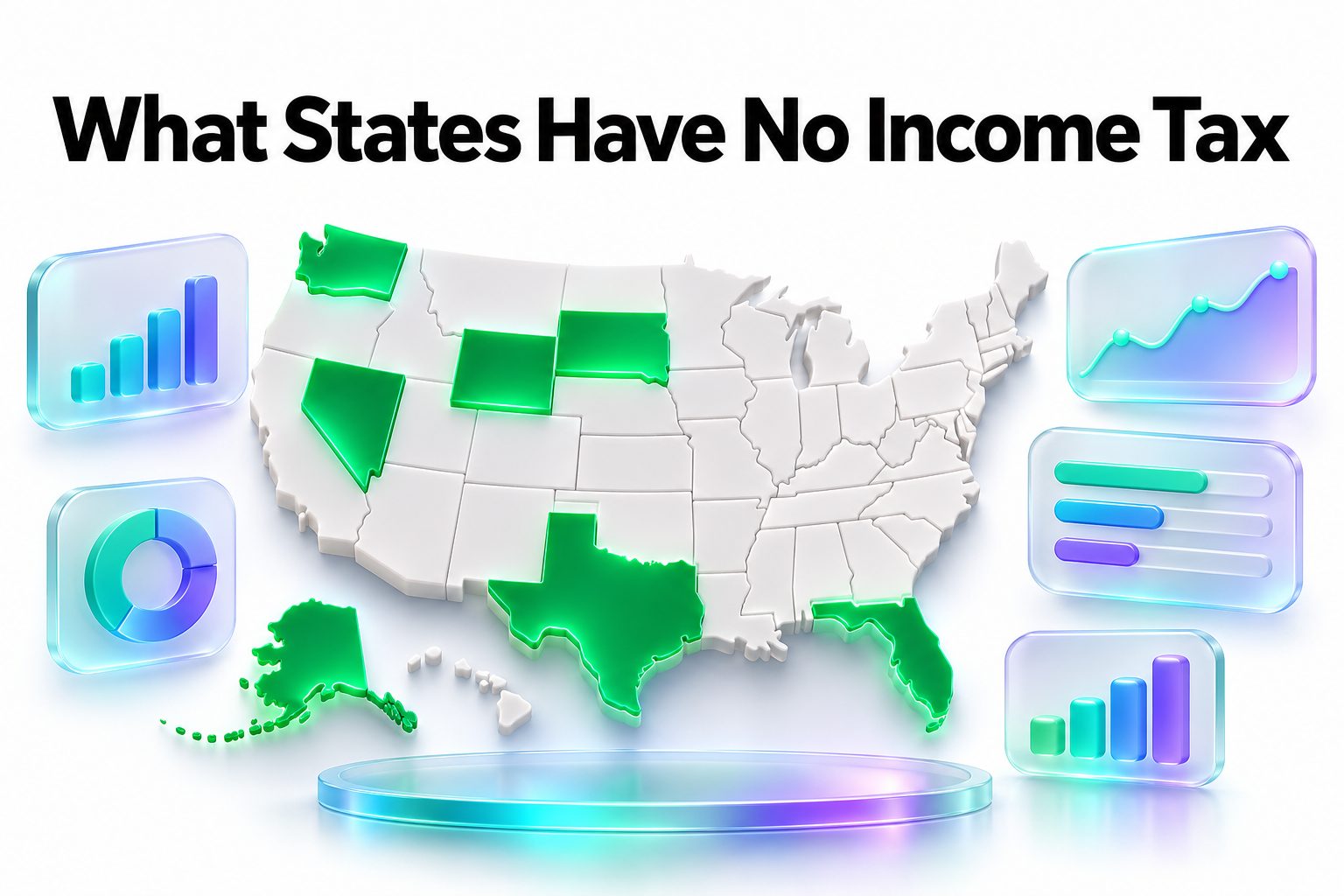
What states have no income tax? As of 2026, nine states do not levy a broad individual income tax on wages: Alaska, Florida, Nevada, New Hampshire, South Dakota, Tennessee, Texas, Washington, and Wyoming. That can make a meaningful difference to take-home pay, especially for high earners, retirees drawing taxable income, remote workers, and business owners.
Still, “no income tax” does not automatically mean a state is cheaper or better for every household. States need revenue from somewhere, and they often rely more heavily on sales taxes, property taxes, business taxes, tourism taxes, or special assessments. Washington, for example, has no general tax on wages but does impose a capital gains excise tax on certain high-income gains. New Hampshire no longer taxes ordinary interest and dividend income, but local property taxes can be substantial.
This article explains which states have no state income tax, what the rule really means, the exceptions worth knowing, and how to compare a potential move without focusing on one tax line alone.
States With No Individual Income Tax
Nine states currently have no broad state-level individual
- Alaska
- Florida
- Nevada
- New Hampshire
- South Dakota
- Tennessee
- Texas
- Washington
- Wyoming
For employees, this generally means your paycheck will not have a separate state income-tax withholding line. You may still owe federal income tax, Social Security and Medicare taxes, and any applicable local or payroll-related taxes. Your employer may also need to follow state-specific rules if you live in one state and work in another.
New Hampshire is the newest full member of this group. It previously taxed interest and dividend income above certain thresholds, but that tax was repealed beginning in 2025. Residents now do not pay a broad individual income tax to the state, though they can still face federal tax on investment income.
What No Income Tax Actually Means
A no-income-tax state does not mean residents pay no taxes. It means the state generally does not tax ordinary individual income such as wages, salaries, self-employment income, pensions, or most retirement-account withdrawals through a standard state income-tax system.
The practical value depends on your income, household structure, deductions, and current state. Someone moving from a high-tax state may save thousands of dollars each year. A household with modest income may see a smaller benefit if higher sales, housing, insurance, or property costs offset the savings.
Key facts to keep in mind:
- Federal income tax still applies regardless of where you live.
- Local governments may charge property taxes, sales taxes, utility taxes, and fees.
- State tax treatment of investment income can differ from tax treatment of wages.
- Business owners may owe franchise, gross-receipts, payroll, or entity-level taxes.
- A lower tax bill does not necessarily mean a lower overall cost of living.
How Each No-Income-Tax State Compares
The nine states share one major feature, but their economies, housing markets, weather, public services, and other taxes are very different. A retiree, a remote employee, and a growing business owner may reach very different conclusions about the same state.
Alaska
Alaska has no state individual income tax and no statewide sales tax. Some municipalities do charge local sales taxes, so the amount depends on where you live and shop. Residents may also be eligible for the annual Alaska Permanent Fund Dividend, although the payment amount varies.
Living costs can be high, especially outside larger communities. Transportation, heating, groceries, and limited housing supply can reduce the value of the state’s favorable tax structure. Alaska may fit people who value outdoor access and can manage its climate and distance from major markets.
Florida
Florida has no individual income tax, which has helped make it popular with retirees, entrepreneurs, remote workers, and high-income households. It has a broad sales tax, and counties may add local surtaxes. Property taxes and homeowners insurance deserve close attention when comparing locations.
Housing costs vary dramatically between inland communities and major coastal markets. Florida also has weather-related risks, including hurricanes and flooding, that can affect insurance premiums and long-term housing decisions. Tax savings are real, but they should be considered alongside those recurring costs.
Nevada
Nevada has no state tax on individual income and is known for its tourism-driven economy. Its statewide sales tax rate is relatively high, and counties may impose additional sales taxes. Property taxes are often more moderate than in many high-cost coastal areas, though market conditions differ by city.
Las Vegas and Reno attract many newcomers because they offer large airports, entertainment, employment options, and access to outdoor recreation. Water availability, summer heat, and housing prices are important considerations, particularly for people planning a long-term move.
New Hampshire
New Hampshire does not levy a broad individual income tax and does not have a general sales tax. This can be appealing for residents who make major purchases or prefer a lower consumption-tax burden. The state’s former tax on interest and dividends has been fully repealed.
The tradeoff is that property taxes can be high, particularly in desirable towns with strong schools or limited housing supply. New Hampshire is also closely tied to the Boston labor market, which can make it attractive for commuters while pushing up real estate prices in some areas.
South Dakota
South Dakota has no individual income tax and generally maintains a business-friendly tax environment. It relies in part on sales taxes, and local rates can increase the final tax paid on purchases. Property taxes vary by county, school district, and the value of the property.
The state is often considered by retirees and business owners looking for a lower-tax base. Before moving, consider employment opportunities, health-care access outside larger cities, climate, and the cost of traveling to family or major airports.
Tennessee
Tennessee has no state income tax on wages or investment income. The state phased out its former tax on interest and dividends several years ago. It funds services partly through sales taxes, which can be high when state and local rates are combined.
Nashville, Knoxville, Chattanooga, and Memphis offer distinct housing and job markets. Tennessee can be attractive for people seeking a mix of urban growth, lower taxes, and access to the Southeast, but home prices and local property-tax bills should be reviewed city by city.
Texas
Texas has no personal state income tax and a large, diverse economy. Its property taxes can be significant, especially in rapidly growing metro areas. Homeowners should look beyond the purchase price and estimate annual taxes, insurance, homeowners association dues, and utility costs.
Texas offers strong job markets in technology, energy, health care, manufacturing, and professional services. The state’s size matters: living in Austin, Dallas, Houston, El Paso, or a smaller town can lead to very different costs, weather conditions, and commuting patterns.
Washington
Washington has no general individual income tax on wages. It does impose other taxes that matter to residents, including sales taxes, certain payroll-related programs, and an excise tax on some long-term capital gains above an annual threshold. The state’s tax rules can be more complex for investors than for typical wage earners.
Seattle and nearby communities can be expensive, while other regions offer lower housing costs and a different pace of life. Washington may be especially attractive to high earners paid primarily through salary, but investors should evaluate capital gains exposure before assuming the state is fully tax-free.
Wyoming
Wyoming has no individual income tax and generally low population density. Its tax system relies heavily on mineral revenue, sales taxes, and property taxes. It can appeal to retirees, remote workers, and people who want access to mountains, open space, and a quieter lifestyle.
The main tradeoffs often involve weather, distance, employment choices, and access to specialized medical care or services. Housing can also be more expensive than expected in popular mountain communities or areas with limited inventory.
Income Tax Exceptions and Important Fine Print
“No state income tax” is a useful shorthand, but it does not describe every tax that may affect your finances. The biggest exceptions tend to involve investment income, business activity, and taxes assessed through payroll or consumer spending.
Washington deserves special attention because it has no standard tax on wage income while still taxing certain long-term capital gains. High-income investors, founders selling stock, and people with concentrated investment positions should seek state-specific tax advice before relocating or selling assets.
New Hampshire’s repeal means ordinary interest and dividend income is no longer subject to the former state tax. That change makes its tax structure simpler for investors, but property taxes remain an important part of the household budget and may outweigh income-tax savings for some buyers.
| State | Broad Tax on Wages | General State Sales Tax | Notable Consideration |
|—|—:|—:|—|
| Alaska | No | No | Local sales taxes may apply |
| Florida | No | Yes | Insurance and housing costs can be high |
| Nevada | No | Yes | Local sales taxes can raise total rates |
| New Hampshire | No | No | Property taxes may be substantial |
| South Dakota | No | Yes | Local rates affect purchase costs |
| Tennessee | No | Yes | Combined sales-tax rates can be high |
| Texas | No | Yes | Property taxes deserve close review |
| Washington | No | Yes | Certain long-term capital gains may be taxed |
| Wyoming | No | Yes | Rural services and travel costs vary |
Comparing Overall Tax Burden Before Moving
The right comparison is not simply one state income-tax rate against another. A move changes your entire financial picture, including home prices, mortgage costs, insurance, transportation, health care, child care, and the taxes embedded in daily spending.
Start with your current annual state income-tax bill, then estimate the other state’s property taxes and sales taxes. A family that rents and spends heavily on taxable goods may feel high sales taxes more than a homeowner with a large property-tax bill. A high-income professional may prioritize the absence of income tax.
Use realistic assumptions rather than statewide averages. Compare the actual county or city where you may live, your likely home price or rent, your expected commute, and the purchases you make regularly. [Internal Link: Cost of Living by State] can help frame that broader comparison.
A practical relocation checklist:
1. Estimate your current state income-tax liability using your most recent tax return.
2. Compare property-tax rates and likely assessed values in your target county.
3. Check combined state and local sales-tax rates for the area.
4. Price homeowners, renters, auto, health, and flood insurance where relevant.
5. Review state treatment of capital gains, retirement income, and business income.
6. Include moving costs, travel to family, and changes in housing or commuting expenses.
7. Consider whether your job, clients, or business operations create tax obligations elsewhere.
Residency Rules Can Affect Your Tax Savings
Moving to a no-income-tax state does not automatically end tax obligations to your former state. States with income taxes may challenge a claimed change of residency if you maintain a home, spend substantial time there, keep family ties there, or continue to treat it as your primary base.
A clean move usually involves more than changing a mailing address. Update your driver’s license, voter registration, vehicle registration, insurance records, banking address, and estate-planning documents. Keep records showing where you spend time, especially if you own homes in more than one state.
Remote employees need to be particularly careful. Your employer’s location, work-travel schedule, and the states where you physically perform work can affect withholding and filing requirements. A payroll department may need time to update your work location and tax setup after a move.
Business Owners Need a Separate Tax Review
Business owners can benefit from living in a no-income-tax state, but business taxes do not disappear. Your company may owe taxes or have filing duties where it operates, employs people, owns property, stores inventory, or earns revenue. Entity type also changes the answer.
A sole proprietor, partnership owner, S corporation shareholder, and C corporation owner may all face different state-level consequences. Texas, for example, has a franchise tax structure, while other states may use gross-receipts taxes, business-license fees, or commercial property taxes.
Before relocating a business, review both your personal residency and your company’s tax footprint. [Internal Link: Small Business Tax Deductions] can be a useful starting point for organizing records, but a multistate business often requires advice tailored to its activities and entity structure.
Common mistakes to avoid:
- Assuming a business owes tax only where its owner lives.
- Selling investments immediately after moving without reviewing state rules.
- Keeping a former state home available for personal use without documenting residency.
- Comparing sales-tax rates without including local additions.
- Ignoring property-tax reassessments after buying a new home.
- Treating a lower tax bill as proof that a location fits your work and lifestyle.
Retirees and Investors Should Look Beyond Wages
For retirees, the absence of wage taxation may matter less than the treatment of retirement distributions, Social Security benefits, investment income, health care, and property taxes. All nine no-income-tax states can be appealing, but their housing costs and services vary widely.
Washington’s capital gains tax is especially relevant to investors with sizable taxable portfolios or a planned business sale. Florida, Tennessee, and New Hampshire may be more straightforward for households focused on dividends, interest, or long-term investment income, though federal taxes still apply.
Retirees should also compare health-care networks, proximity to specialists, climate preferences, and travel access. A lower state tax burden can help preserve retirement income, but frequent travel, high insurance premiums, or expensive housing can narrow that advantage.
Choosing a State That Fits Your Situation
A no-income-tax state can be a strong financial choice when you have high taxable income, flexible work options, or a desire to preserve more of your earnings. It is less compelling if the move increases housing, insurance, or lifestyle expenses beyond the state-tax savings.
Think in terms of a five-year plan instead of a single tax year. Consider your career path, children’s schooling, retirement timeline, housing needs, business plans, and support network. A state that saves money today may not be the best fit if it makes other goals harder to achieve.
The best choice is usually the one that combines a favorable tax structure with a location you can realistically enjoy and afford. Tax policy should inform the decision, not make the decision by itself.
Conclusion
The short answer is that Alaska, Florida, Nevada, New Hampshire, South Dakota, Tennessee, Texas, Washington, and Wyoming do not impose a broad individual income tax on wages. That can increase your take-home pay and reduce annual tax costs, particularly if you are moving from a state with higher income-tax rates.
Still, the smartest comparison goes beyond one line on a paycheck. Sales taxes, property taxes, insurance, home prices, local fees, and investment-related rules can materially change the value of a move. Washington’s treatment of certain capital gains and New Hampshire’s property-tax burden show why broad labels can miss important details.
Before relocating, compare the actual city or county you are considering, estimate recurring household costs, and review residency rules if you will retain ties to another state. For many households, knowing what states have no income tax is the right starting point. The final decision should reflect your full financial picture, career plans, and preferred way of living.
Frequently Asked Questions
Which states have no state income tax?
Alaska, Florida, Nevada, New Hampshire, South Dakota, Tennessee, Texas, Washington, and Wyoming have no broad individual income tax. Washington has separate rules for certain long-term capital gains, so investors should review those rules carefully.
Does Washington tax income?
Washington does not impose a general state income tax on wages or salaries. It does levy a tax on certain long-term capital gains above an annual exemption amount, along with sales taxes and some payroll-related assessments.
Does New Hampshire have income tax?
New Hampshire no longer has a broad individual income tax. Its former interest and dividends tax was fully repealed in 2025. Residents still pay federal income taxes and may face relatively high local property taxes.
Are no-income-tax states always cheaper?
No. A state without income tax may have higher sales taxes, property taxes, housing costs, insurance premiums, or other fees. Compare your full household budget rather than relying only on the state income-tax rate.
Can I avoid taxes by moving to Texas?
Moving to Texas can eliminate personal state income tax on future income, but federal income taxes still apply. You may also owe property taxes, sales taxes, and tax to another state if you retain residency or business ties there.
Leave a Comment